Fifty Years Behind The Scenes
... and the rest!– a totally prejudiced autobiography
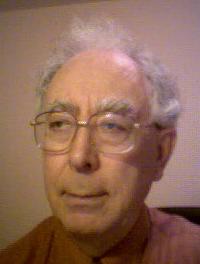
That’s me in the top left-hand corner. The only reason it’s there is to improve the look of the page, though some people might disagree.
Leaving aside blatant exhibitionists and those, presumably unemployed, people who use their web space as somewhere to post their CV, I’ve often wondered why individual people have home pages at all. In my case, all I really want to do is to publicise my local amateur dramatic society and have a bit of fun with HTML on the way. As an added bonus, it may also provide enough clues to enable any long lost friends, colleagues and acquaintances who may stumble across this page to be able to identify me as the real John Larkham and not some imposter (There are many such scoundrels, as a visit to www.192.com or a search with any reputable seach engine will confirm.).
Funny, isn’t it, how our hobbies, interests and, indeed, some quite major happenings in our lives are influenced by comparatively trivial events? My interest in classical music, for instance, stems not from childhood piano lessons, which were largely a failure, but from a marvellous Hallé concert I was taken to by a close friend of the family when I was about 15. And my love of traditional jazz stems from a Chris Barber concert I was persuaded to attend (Thanks Sonia, wherever you are.) a few years later. And so it was with the theatre.
I was born at Ringwood, Hants, England, in 1937. By the time I was old enough to be properly aware of the world around me, World War II was in full swing. My school (Ringwood Council) was full of evacuees from Southampton and posters urging us to “Dig for Victory” and telling us how to identify the Colorado Beetle. Bus tickets carried the slogan, “Beat the paperhanger – be a paper saver.” Down at the seaside, the beach was barricaded off with concrete blocks and barbed wire and the ice cream was a funny greyish colour. And at night, everything was pitch black – except for the searchlight beams which swept across the sky from the RAF aerodrome about 3 miles away from our house.
You can imagine that, in the midst of all this austerity, our annual visit to the pantomime was particularly enjoyable. We were lucky that our nearest theatre, Bournemouth Pavilion, was of the large municipal variety, having an enormous stage with a big fly tower, revolve, traps and all the lighting equipment one could wish for, not to mention an orchestra pit that could be raised and lowered on a hydraulic lift. It goes without saying that its pantomimes were very spectacular indeed, often including such things as huge floodlit waterfalls. Needless to say, I was completely mesmerised and I’m sure that my passion for dramatic lighting and fast, smooth scene changes dates from that time.
Brockenhurst County High School (where I went daily on the train from 1948 to 1956) had, for that time, a well-equipped stage – at least as far as lighting was concerned – so it was inevitable that I eventually became involved, quickly graduating from spotlight operator to the lighting platform. The lighting consisted of three three-colour (blue, blue-green and golden amber) battens, an “area flood” (which lit a circular mid-stage area from directly above!), footlights in the same three colours and a pair of enormous carbon arc follow spots in the balcony. There were a few other lamps (Strand patt. 45 or similar, I think) available to put on stands in the wings. In those days of course there were no thyristors or triacs so all the dimmers were slider type Strand rheostats. Since the lighting platform was positioned above the curtain winder, eight feet up in the downstage left corner, and the dimmers were arranged on the two adjacent walls, in groups of three, operating them frequently involved the simultaneous use of both arms and legs, with the aid of a number of short wooden battens. All good fun, despite having as director a cross-eyed and apparently colour-blind English master.
At Bristol University(1956-59) I probably spent more time reading (but not necessarily absorbing) physics than doing theatrical things, though I did build some scenery for a club known, for obvious reasons, as the Revunions. It was at Bristol, though, that I first acquired a taste for ‘real’ theatre, in the shape of the Bristol Old Vic.
After graduating, I joined UKAEA Industrial Group, eventually absorbed into BNFL, at Calder Hall nuclear power station, initially as a physicist in Technical Section and then in the Operations Department. In 1968 I moved across the river to Windscale where I remained until my retirement in 1994 – first as a programmer and systems analyst in Computing Sservices and then as a founder member of the Technical Documentation Group, where I acquired a great enthusiasm for desktop publishing.
But I race ahead too fast and, as far as my association with the stage is concerned, off-topic, so let me return to my arrival at Sellafield in 1959. In those days, UKAEA was recruiting as fast as it could and new arrivals were lodged in a hostel somewhat optimistically entitled “Greengarth Hall” – “green” being the predominant colour of the paintwork, “garth” being a Cumbrian word for an enclosure, and “hall” being a total figment of the imagination. It bore a close resemblance to an army camp – indeed, at one time it had been run by the Ministry of Defence. Still, some of the newer rooms were quite comfortable and there was a bar, a shop, a snooker room, a big lounge, a TV room, a canteen (you couldn’t call it a restaurant) and a hall where there was a weekly dance and a twice-weekly cinema show. At £3.6s.6d (that’s £3.32½ in today’s money, kids) for board and lodging, you couldn’t grumble, though of course we did when it went up by 10/- (50p). “What’s this got to do with the theatre?” you may ask. The answer is an annual revue (this was the golden age of revue – “Beyond The Fringe” etc) imaginatively known as The Greengarth Christmas Show and famed throughout West Cumbria (or West Cumberland as it then was). The hall where the dances and film shows were held contained a small stage and it was here that one Edgar Moore used to produce his annual extravaganza. Needless to say I got involved, and this is where I learned the art of painting backcloths, including the double sided kind with one scene painted upside down on the back of another and hung over a scaffolding pole suspended below the ceiling for a super-rapid scene-change – in the Greengarth Show, swift scene changes in near total darkness were essential – more than five seconds and you were dead meat, for if Edgar didn’t get you, then the not-altogether-sober first night audience most surely would! As for stage lighting, suffice it to say that it was both primitive and minimal.
It was during my time at Greengarth Hall that my arm was twisted and I found myself as the unpaid editor of a notorious and highly irreverent works magazine called Nucleus, which would never be tolerated by present-day paranoid management, but in those days we were enthusiastic pioneers in a new industry. Everything was exciting, “political correctness” had, thankfully, not been invented and just about anything went! Of course, this has nothing to do with the theatre but a lot to do with my later move into computer based publishing which, however, has definite theatrical applications in the areas of publicity, programmes etc.
In 1963, I was introduced to Gosforth Amateur Dramatic Society by a colleague who shall remain nameless but, at the time, was rather keen on a certain female member. We, and a number of others from Greengarth, joined the society where, eventually, I was able to do some creative lighting, following the well-established guidelines laid down by Stanley McCandless and spelt out in the publications of Fred Bentham, Francis Reid, Richard Pilbrow and other great lighting gurus. Not straight away, you understand, because at the time the society’s entire lighting equipment consisted of two Strand patt. 23 500W profile spots and two equivalent Furse spots front of house and, over the stage, about four patt. 137 baby floods augmented by a number of bare 100W bulbs in white metal lampshades, with more 100W bulbs in home made reflectors behind doorways. This lot was controlled by a dozen Strand rheostat dimmers mounted on a board situated backstage where you couldn’t see a blind thing, so everything was done on sound cues.
Over the next few years, however, we invested in another pair of patt. 23s and a variety of other 500/650W lumieres from Rank Strand, CCT and other manufacturers. We also acquired an old but serviceable Rank Strand Mini 18 channel, 2-preset control desk and three dimmer packs from the Century Theatre in Keswick, plus associated control cables. This allowed us to control our lighting from the back of the hall, from where we could, for the first time, see what was happening on the stage and the lighting effects we were getting. This was most important because we had now started producing our annual pantomimes, the first few written jointly by Geoff Gibbens and myself. The society’s latest acquisition of a brand new Rank LX24 control desk and two more dimmer packs has now greatly increased the flexibility of the lighting system and all we need now is an increased power supply to the Public Hall, an additional six feet in the wings, a 20-foot fly tower, at least double the storage space..... Sadly all this is outside our control, but I can still dream.
My activities at Gosforth haven’t been confined to lighting and pantomime writing, of course. In fact, right from the time of joining, I have been involved in set construction which, up to the late sixties, when we acquired a room in the Public Hall, was carried out at the premises of the late John Moore, the village joiner, who also happened to be a member of the society, and transported to the Public Hall in his van. Well, some of it stuck out of the back, but we tied a white cloth to the end and nobody minded. I have to say that I learned more about woodwork from John than I ever did from my old woodwork master at Brockenhurst – and he didn’t hit people with chair legs either!
The pantomimes posed new challenges to us in the areas of lighting and set design – especially the latter, since the Public Hall stage has a low ceiling and only two or three feet of wing space at most so, over the years, we have all acquired vast experience in the design of a variety of sliding, folding and rotating flats and nowadays most of the backstage crew can paint a decent looking backcloth. In 1983, we began entering one act plays in the All-England Theatre Festival, since when I seem to have become adept in the art of constructing light-weight scenery capable of filling a stage whilst also being able to collapse or fold into an impossibly small volume for transportation to and from the festival venue in a hired van.
You will notice that, up to this point, I have said nothing about my acting abilities, and probably wisely so! Suffice it to say that, prior to joining GADS, my only acting experience had been in a French play at school, where I had but three lines to remember: “Garçon! Un vol-au-vent!”; “Est-ce qu’il va venir mon vol-au-vent?”; “Enfin!” Oddly enough, those are still the only lines, out of all the many plays I’ve been unfortunate to be arm-twisted into appearing in, that I can remember – with the notable exception of the memorable line, “Dinner is served”, in The Peaceful Inn which, for some reason unfathomable to me, brought the house down. I really should stay firmly backstage!
I live, with my wife, Lorrie, in the seaside village of Seascale – once, with a little help from the Furness Railway Company, a Victorian holiday resort. Despite its damp and windy climate, the village has a lot going for it. Its extensive beach is now cleaner and sandier than ever, thanks to the efforts of North West Water (now gobbled up by United Utilities), and there are some spectacular sunsets across the Irish Sea. For those of a sporting nature, there is a thriving golf club, bowls club and cricket club and a small sports hall. Climbers, walkers and other lovers of the great outdoors will be attracted by its proximity to the western lakes, in particular Wastwater and Ennerdale Water, and the spectacular scenery which surrounds them. This is an area which, due largely to its comparative inaccessibility, remains almost totally untouched by the commercialism which now afflicts much of the Lake District. Other local attractions include Eskdale, with the famous narrow gauge Ravenglass and Eskdale Railway, Muncaster Castle with its famous owl centre.Sadly, the former Sellafield Visitors’ Centre is now called the Sellafield Centre and is mostly used for business events. A small section is still open to the public but only at selected times. The downside of living in a relatively unpopulated area, of course, is the distance you have to travel to the nearest IKEA, B&Q Warehouse or Sainsbury’s, or to a really decent cinema, theatre or concert hall.
If you want to find more about Seascale and the surrounding area, there’s now quite a lot on the Internet.
Interests (not necessarily in order of importance):
- All aspects of amateur theatre – especially lighting and other backstage activities and writing and producing pantomimes, but will also appear on stage with the aid of some heavy arm-twisting. A member of Gosforth Amateur Dramatic Society since 1963.
- Photography – This goes back a long time, my first efforts being with an old Agfa folding camera when I was about eleven years old. Many people doubt if I’ve ever improved since, even though I’m now digital.
- Failing to solve the Beale Cipher (If you want to know more about this, there’s plenty on the Internet – just point your favourite search engine at “Thomas Jefferson Beale”, “treasure” and “Roanoke” – but there’s no way I’m going to hyperlink you away from this site!)
- All kinds of music: I’m a close contender for the positions of the world’s worst pianist and the galaxy’s worst double bass player (with apologies to all ex-members of the now defunct Gloryland Jazz Band) and currently, I’m working hard at becoming the known universe’s worst drummer. All I want is a lot more practice. Honestly!
- The printed word – page design, typography etc: No doubt a consequence of my time as editor of Nucleus and my later spell in the Sellafield technical documentation group, further inspired by an excellent course given by DTP guru Gareth Powell and the writings of Colin Wheildon.
- Computing, especially publishing applications.
- Tracing my by-no-means famous ancestors.
- A dormant interest in light hovercraft, cut short in the late sixties largely because of a lack of welding equipment, a suitable workshop space, time and money, but one day ... I’m sad, though that there has been virtually no real progress in the design and usage of these vehicles over the last half-century or so.
- Making the prices of carefully selected shares plummet – just by buying them. I really excel at this!
- .... and lots of other things